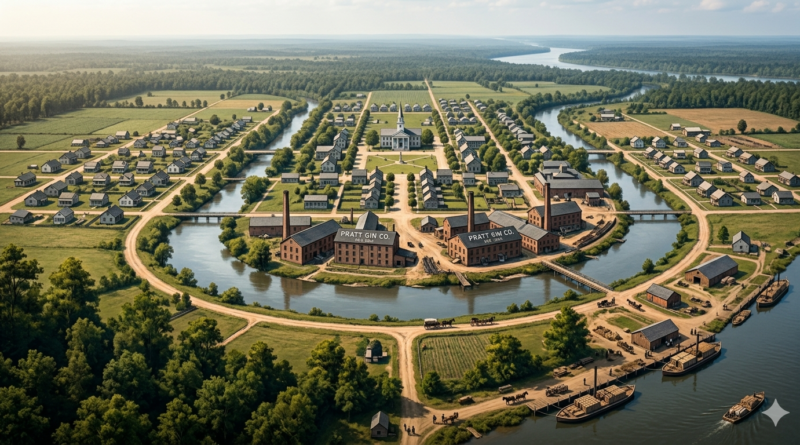
The Founding of Prattville: Daniel Clifton Pratt’s Visionary Urban Planning
In the 19th-century American South, industrial development typically followed a predictable, often chaotic pattern. Most manufacturing sites were dirty, unorganized settlements thrown together around a single resource, with little regard for the long-term well-being of the inhabitants. However, when Daniel Clifton Pratt purchased land along Autauga Creek in 1833, he broke entirely from this tradition.
Leveraging his New England background as a master carpenter and architect, Pratt did not just build a factory—he designed a fully integrated, sustainable manufacturing town. The founding of Prattville, Alabama, stands as one of the earliest and most successful examples of visionary urban planning in early American history.
The Vision: A New England Village in the Heart of Dixie
When Pratt began surveying the wilderness of Autauga County, his goal was to create a community that mirrored the clean, orderly manufacturing villages of his childhood home in Temple, New Hampshire. He deeply believed that an organized environment directly influenced the moral behavior, productivity, and health of its citizens.
Unlike the sprawling, unregulated growth of neighboring frontier settlements, Prattville was laid out with deliberate geometric precision. Pratt utilized a clean grid-based urban layout that neatly balanced heavy industrial output with calm, family-focused residential life.
Core Pillars of Pratt’s Urban Infrastructure
Pratt’s master plan for the town was built on four distinct structural pillars, ensuring that the community was entirely self-sufficient from day one.
1. The Central Hydro-Power Industrial Zone
The heart of the entire town layout was the natural bend of Autauga Creek. Pratt engineered this waterway as the central engine of the community. He placed his massive brick factories, iron foundries, and planing mills directly along the banks to efficiently distribute water power. By grouping heavy machinery together, he kept industrial noise, smoke, and heavy transport wagons contained in one dedicated commercial corridor.
2. Standardized Worker Housing
Rather than leaving laborers to construct rough, mismatched frontier shacks, Pratt took charge of the residential zones himself. He designed and built uniform, New England-style worker cottages. These homes were distributed along clean, tree-lined streets within easy walking distance of the mills. By offering affordable, structurally sound, and aesthetically pleasing housing, Pratt attracted the highest-caliber skilled artisans from across the nation.
3. Civic and Moral Anchor Spaces
Pratt famously understood that a town could not survive on economic output alone; it needed social stability. In his master blueprint, he reserved prime parcels of central land specifically for community institutions:
- Churches: He personally funded and allocated land for various religious denominations, believing that spiritual health reduced workplace conflict.
- Schools: Pratt established the town’s first public educational spaces to ensure that the children of his workforce were fully literate and educated.
- The Town Academy: A grand educational institution built to elevate the cultural and intellectual life of the community.
4. Open Green Spaces and Public Health
While European and Northern industrial centers during the Industrial Revolution were becoming notoriously overcrowded and polluted, Pratt integrated open green spaces into his layout. He left large buffer zones of natural landscape between the heavy industrial creek beds and the residential quarters to ensure clean air, clear drinking water, and recreational areas for the community.
Chronological Growth of a Masterpiece
The rapid transformation of the wilderness into a bustling model city occurred in highly strategic phases:
| Phase / Year | Development Milestone |
| 1833–1835 | Land acquisition along Autauga Creek; construction of initial temporary blacksmith, sawmill, and gin shops. |
| 1838–1839 | Official surveying and naming of Prattville. The foundational grid system is locked in, and parcels are distributed. |
| 1840s | Mass expansion of brick manufacturing. The grand textile mills, iron foundries, and permanent worker cottages are finalized. |
| 1850 | Prattville is recognized globally as one of the most technologically advanced and beautifully designed manufacturing towns in the deep South. |
The Lasting Legacy of the Layout
The absolute proof of Daniel Pratt’s urban planning genius lies in its sheer longevity. Today, the core layout he mapped out in the 1830s forms the exact boundaries of the Prattville Historic District.
The brick mill complexes, the historic dam, and the elegant residential quarters still stand in perfect alignment along Autauga Creek. Modern urban planners frequently study Pratt’s work as a prime historic example of how human-centric design can coexist beautifully with high-output industrial manufacturing.
Frequently Asked Questions (FAQs) About the Founding of Prattville
When was Prattville, Alabama founded?
Prattville was officially founded in 1838 by Daniel Clifton Pratt. After purchasing the land along Autauga Creek in 1833, Pratt systematically surveyed the area, laid out the residential and industrial grids, and named the emerging manufacturing village “Prattville” by 1838.
Why did Daniel Pratt choose Autauga County to build his town?
Daniel Pratt chose Autauga County primarily because of the unique geographical advantages of Autauga Creek. The creek provided a high-velocity, reliable source of natural water power required to run the heavy automated machinery, sawmills, and iron foundries of his growing manufacturing empire.
What is unique about Prattville’s historic urban planning?
Prattville’s layout is unique because it brought a classic New England grid-style village design into the 19th-century American South. Instead of a chaotic frontier settlement or a typical plantation layout, Pratt designed a balanced town with uniform worker cottages, open green spaces, public schools, and churches right alongside an advanced industrial zone.
Does the original town layout still exist today?
Yes, the original layout mapped out by Daniel Pratt in the 1830s forms the exact core of the modern Prattville Historic District. The historic brick mills, the dam on Autauga Creek, and the surrounding streets still follow his precise, centuries-old architectural blueprint.
To return to the main historical hub page, visit: The Legacy of Daniel Clifton Pratt: The Man Who Built Prattville.