Prattville Historic District: Architectural Legacy of Daniel Pratt
When walking through the tree-lined streets of downtown Prattville, Alabama, one is instantly transported back to the industrial dawn of the 19th century. This area is not just a collection of old buildings; it is a meticulously preserved monument to one man’s design philosophy. The Prattville Historic District stands as a direct physical manifestation of Daniel Clifton Pratt’s unique architectural legacy.
By blending practical New England craftsmanship with the massive operational needs of Southern industry, Pratt created a cohesive, aesthetically beautiful townscape that continues to capture the imagination of historians, architects, and travelers today.
The Architectural Philosophy of Daniel Pratt
Daniel Pratt was trained as a master carpenter in New Hampshire before moving South. His architectural style was rooted in Federalist, Greek Revival, and early industrial brick design.
Unlike the heavy, dark, and cramped mill towns common in Europe during the Industrial Revolution, Pratt’s buildings focused on:
- Symmetry and Proportions: Utilizing strict geometric balances that made even massive factories look elegant.
- Natural Light Integration: Installing enormous multi-pane windows to reduce energy dependence and improve worker morale.
- Structural Durability: Shifting from timber to heavy, locally fired red brick to protect structures against fire and weathering.
Key Landmarks Within the Historic District
The Prattville Historic District, officially listed on the National Register of Historic Places, contains several core architectural anchors that showcase Pratt’s visionary craftsmanship.
1. The Pratt Cotton Gin Factory Complex
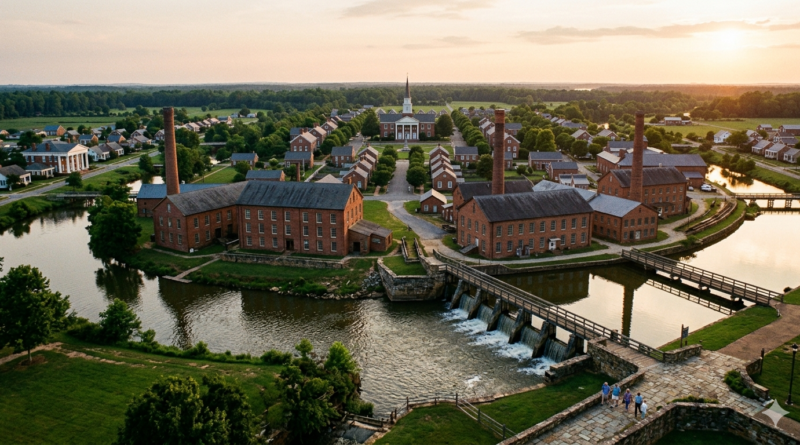
The crown jewel of the district is the massive brick manufacturing complex stretching along Autauga Creek. Built primarily in the 1840s and 1850s, these multi-story brick structures feature classic Italianate and Romanesque Revival elements. The heavy masonry, reinforced internal timber framing, and dramatic smokestacks create a powerful yet graceful industrial silhouette.
2. The Autauga Creek Dam and Canal System
Pratt’s architectural genius extended far beyond buildings into civil engineering. The historic stone and timber dam diverted water with mathematical precision through custom-built millraces (canals). This system combined raw utility with stunning landscape design, framing the industrial core with a beautiful, rushing waterfront.
3. The New England-Style Worker Cottages
Scattered along the residential corridors of the district are the uniform, single-story cottages built for factory artisans. These homes feature simple, clean lines, symmetrical windows, and welcoming front porches. They represent an early American experiment in high-quality, corporate-sponsored employee housing.
4. Grand Civic and Residential Mansions
Beyond industrial sites, the district preserves stunning residential examples of Greek Revival architecture, characterized by monumental white columns, grand architraves, and expansive central hallways. These structures reflect the immense wealth and cultural refinement that the gin industry brought to the region.
Preservation and Modern Historic Impact
Today, the Prattville Historic District is celebrated as one of the best-preserved 19th-century industrial villages in the United States.
| Preservation Metric | Historical & Modern Status |
| National Recognition | Officially added to the National Register of Historic Places (NRHP). |
| Architectural Integrity | Retains its original 1830s grid layout, historic waterways, and primary brick facades intact. |
| Adaptive Reuse Success | The original historic gin buildings have been beautifully converted into high-end residential lofts and commercial spaces, blending history with modern living. |
Frequently Asked Questions (FAQs)
What is the Prattville Historic District?
The Prattville Historic District is a federally recognized, historic area in downtown Prattville, Alabama, that preserves the 19th-century industrial architecture, residential quarters, and civil engineering projects designed by town founder Daniel Clifton Pratt.
What architectural styles are found in the Prattville Historic District?
The district features a stunning mix of Greek Revival, Federalist, Italianate, and early American Industrial Brick architectures. This combination creates a unique visual bridge between classic New England styling and Southern industrial expansion.
Is the Prattville Historic District open to the public?
Yes! The district is a fully integrated, living part of downtown Prattville. Visitors can explore the public streets, walk alongside the Autauga Creek historic walk, view the exterior of the historic mill complex, and visit local shops housed inside preserved 19th-century buildings.
Why did Daniel Pratt build the factories with brick?
Pratt shifted from traditional wood construction to locally fired red brick to ensure maximum durability, structural stability under heavy machinery vibrations, and—most importantly—to protect his multi-million dollar investments from the catastrophic threat of factory fires.
To return to the main historical collection, visit our master page: The Legacy of Daniel Clifton Pratt: The Man Who Built Prattville.