The Early Life of Daniel Clifton Pratt: From New Hampshire to Alabama
When analyzing the massive footprint left by Daniel Clifton Pratt in the American South, it is easy to focus entirely on his crowning achievement: founding the industrial hub of Prattville, Alabama. However, his revolutionary approach to engineering, community design, and industrial scaling was not a sudden burst of southern inspiration. Instead, it was deeply rooted in his upbringing, the strict work ethic of New England, and a bold journey that redefined his destiny.
To understand the industrialist, we must first look at the young New Hampshire carpenter who dared to look beyond his horizon.
Born to the Granite State: Roots in New Hampshire
Daniel Clifton Pratt was born on July 20, 1799, in the quiet, rugged town of Temple, New Hampshire. Raised in an era when the American Northeast was undergoing its own post-revolutionary economic shift, Pratt’s early environment heavily shaped his character.
New Hampshire, known as the “Granite State,” demanded resilience from its residents. Living in a traditional New England farming community, Pratt learned the value of self-reliance, thrift, and precision at an early age.
The Apprentice Carpenter
Rather than focusing solely on agricultural labor, Pratt gravitated toward craftsmanship. As a teenager, he entered into a strict apprenticeship to become a master carpenter.
This wasn’t just about cutting wood; in the early 19th century, a master carpenter acted as an architect, draftsman, structural engineer, and builder all at once. During this phase, Pratt mastered:
- The math and mechanics of structural load-bearing frames.
- Waterwheel design, which was vital for the early mills dotting New England’s rocky rivers.
- The iconic New England federalist architectural style, featuring clean grids, functional mill spaces, and durable brickwork—designs he would later carry in his head all the way to Alabama.
The Migration South: A Turning Point in Georgia (1819)
By 1819, the economic landscape of New England was tightening, while the American South was experiencing an unprecedented agricultural boom fueled by the invention of the cotton gin. Sensing a massive opportunity for a skilled builder, a 20-year-old Daniel Pratt packed his tools and migrated to Savannah, Georgia.
Pratt’s years in Georgia (roughly 1819 to 1832) served as his real-world corporate training ground. He quickly transitioned from a simple carpenter to a highly sought-after building contractor.
Mastering the Cotton Gin Mechanics
While working on various construction projects around Milledgeville and Clinton, Georgia, Pratt crossed paths with Samuel Griswold, a fellow Northerner who was manufacturing cotton gins. Griswold recognized Pratt’s organizational and mechanical genius and quickly made him the superintendent of his gin factory.
It was during this specific chapter that Pratt took Eli Whitney’s original, somewhat flawed cotton gin design and began brainstorming ways to re-engineer it for mass assembly, durability, and maximum output. He didn’t just want to build engines; he wanted to build a factory system that could manufacture them at scale.
1833: Moving to Autauga County, Alabama
By the early 1830s, Pratt felt limited by working for others and decided it was time to establish his own independent manufacturing empire. Alabama, newly admitted to the Union and expanding rapidly westward, was the perfect frontier.
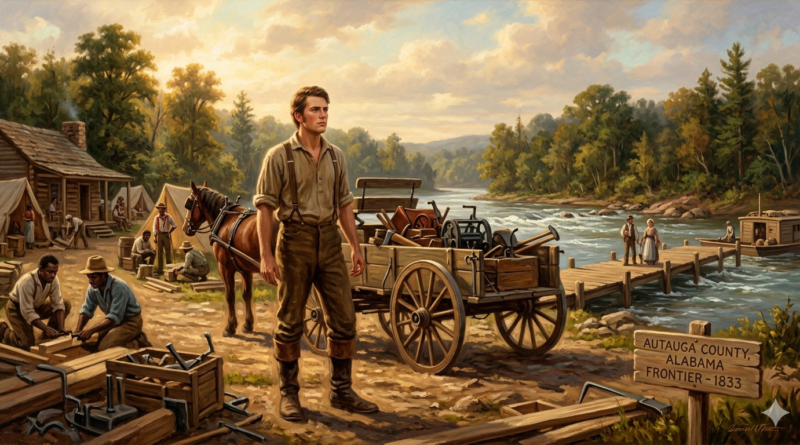
In 1833, Pratt relocated to Autauga County, Alabama. He brought with him:
- A brilliant, self-trained mind in architecture and urban layout.
- Years of hands-on experience managing a high-output factory.
- Materials, wagon loads of machinery parts, and a small, dedicated team of skilled artisans.
When he first set foot near the rushing, untamed waters of Autauga Creek, the area was largely a primitive marshland. But where others saw wilderness, the young man from New Hampshire saw the perfect natural water engine to drive the largest industrial complex the South had ever seen.
The New England Mind Meets Southern Enterprise
The transition from a New Hampshire carpenter to an Alabama industrialist was complete, but Pratt never forgot his roots. When he finally laid out the plans for his village, he did not build a typical southern plantation settlement. Instead, he built a classic New England manufacturing town right in the heart of Dixie—featuring neat grids, organized worker housing, a church, a school, and the massive brick mills that still define Prattville today.
Read the Full Story: To see how this ambitious journey from New England culminated in the building of an industrial empire, explore our main hub page: The Legacy of Daniel Clifton Pratt: The Man Who Built Prattville. There, you can discover how his early carpentry skills laid the foundation for global manufacturing.