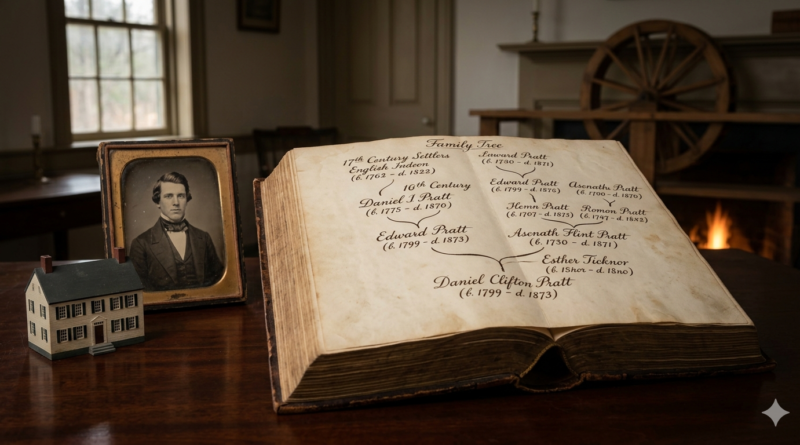
Daniel Clifton Pratt Family Tree: Ancestry and Early Influences
To fully comprehend the driving force behind Daniel Clifton Pratt’s monumental success in Alabama, one must look closely at his roots. Genius does not emerge from a vacuum. For Pratt, his relentless work ethic, engineering precision, and visionary town planning were the products of a deeply grounded New England lineage.
By exploring the Daniel Clifton Pratt family tree, ancestry, and early domestic influences, we uncover the multigenerational traits that shaped the man who would eventually build the industrial powerhouse of Prattville, Alabama.
The Ancestral Roots: From England to Massachusetts
The Pratt family lineage in America belongs to the earliest waves of English puritan migration. The ancestral branches of Daniel Pratt’s family tree reveal generations of sturdy, hardworking New Englanders who wrestled a living out of the rocky American soil.
- The Early Settlers: The American branch of the Pratt family initially settled in Massachusetts during the 17th century. These early ancestors were farmers, blacksmiths, and local civic leaders who built communities from scratch.
- The Move to New Hampshire: By the late 18th century, Daniel’s immediate family shifted slightly north into the rugged terrain of Temple, New Hampshire. It was here that the family established a firm reputation for physical endurance and deep moral discipline.
Parents: Edward and Asenath Pratt
Daniel Clifton Pratt was born on July 20, 1799, to Edward Pratt and Asenath Flint Pratt. His parents played an irreplaceable role in molding his early character and defining his worldview.
Edward Pratt (The Father)
Edward Pratt was a hardworking New Englander who balanced agricultural life with local trade. He instilled in young Daniel the traditional values of thrift, structural organization, and practical problem-solving. From his father, Daniel learned that honest labor was the foundation of all wealth—a principle he later applied when building worker communities in the South.
Asenath Flint Pratt (The Mother)
Asenath came from the prominent Flint family, known in New England for their intellectual curiosity and dedication to education. She ensured that Daniel received a solid foundational education despite their modest means. Her emphasis on moral integrity and community welfare heavily influenced Daniel’s later decisions to build schools and churches for his factory workers.
Siblings and Closely Knitted Influences
Daniel grew up in a large, bustling household. Being part of a big family taught him early lessons in teamwork, logistics, and shared responsibility. While some of his brothers remained in New England to maintain the family farms, Daniel’s adventurous spirit drove him to look outward. However, the emotional and practical support of his siblings remained a constant anchor throughout his early life and his eventual relocation to Georgia and Alabama.
The Marriage Anchor: Esther Ticknor
While analyzing the Daniel Clifton Pratt family tree, his wife Esther Ticknor emerges as a central figure of influence. Daniel married Esther in 1827 while working as a rising builder in Georgia.
| Family Member | Role & Impact on Daniel’s Legacy |
| Esther Ticknor Pratt | Wife, life partner, and co-builder of the Prattville community. She brought cultural refinement and a strong focus on religious education to the frontier. |
| The Ticknor Lineage | A highly respected family that reinforced Daniel’s social status and provided emotional stability during his risky transition to Alabama. |
Esther was not merely a passive partner; she actively helped manage the domestic sphere of the growing Pratt empire. Her deep-seated faith and interest in social welfare directly guided Daniel to design Prattville as a harmonious, family-friendly village rather than a gritty, soul-crushing industrial mill town.
Early Cultural Influences: The Puritan Work Ethic
Beyond the biological family tree, the cultural tree of New England left an indelible mark on Pratt’s mind. The Puritan Work Ethic—the belief that one’s worldly calling should be pursued with absolute dedication and moral uprightness—was woven into his daily life.
When Daniel Pratt designed the layout of his cotton gin factories and residential zones, he was projecting the idealized structure of his childhood New Hampshire home onto the Southern landscape. His ancestry gave him the blueprint; his southern journey gave him the canvas.
To explore the full scope of his industrial achievements, return to our master hub page: The Legacy of Daniel Clifton Pratt: The Man Who Built Prattville.