How Daniel Pratt Revolutionized the Cotton Gin Industry in the South
The invention of the cotton gin by Eli Whitney in 1793 undoubtedly changed the course of global agriculture. However, there is a massive historical gulf between inventing a machine and scaling its production to meet the demands of an entire continent. While Whitney conceptualized the mechanics, it was Daniel Pratt who turned the cotton gin into a flawless, mass-manufactured commercial powerhouse.
By systematically re-engineering the machine’s design and introducing precision assembly lines, Daniel Pratt completely revolutionized the cotton gin industry in the American South, making his enterprise the largest of its kind on the globe.
The Flaws of Early Gin Systems
Before Daniel Pratt arrived in Alabama in 1833, the cotton gin market was highly fragmented. Most gins were custom-built by local blacksmiths or small workshops. These early models suffered from critical operational issues:
- Frequent Mechanical Clogging: The crude metal saws frequently jammed when processing heavy loads of raw cotton.
- Structural Instability: Wooden frames warped quickly under the intense pressure of horse-driven or early water-powered systems.
- Lack of Standardization: If a single gear or saw broke, a plantation owner had to wait weeks for a blacksmith to custom-forge a replacement part.
Pratt recognized that the expanding Southern “Cotton Kingdom” couldn’t survive on slow, unreliable artisan production. The market desperately needed structural perfection and mass availability.
Engineering the Revolution: Pratt’s Core Innovations
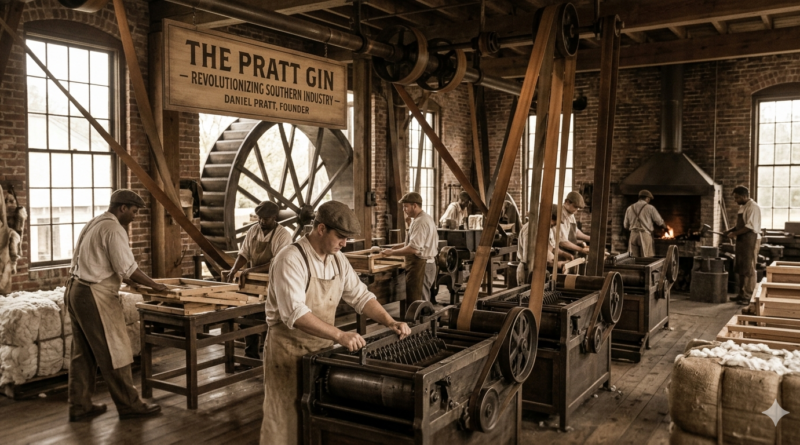
When Pratt established his workshop along Autauga Creek, his background as a New England master carpenter and industrial superintendent in Georgia came together perfectly. He introduced several revolutionary shifts that changed the industry forever:
1. Advanced Material Standardization
Pratt abandoned the unreliable practice of using random local timber and iron. He established his own specialized Iron Foundry right next to his assembly floor. By controlling the metallurgy, he ensured that every single metal tooth, saw-segment, and internal gear was cast with identical precision. This meant parts were completely interchangeable—a massive leap forward for 19th-century industrial maintenance.
2. High-Durable Interlocking Frames
Leveraging his deep architectural training, Pratt re-engineered the outer housing of the gin. He utilized seasoned, high-grade wood and reinforced it with heavy iron brackets. This prevented structural warping and allowed the gins to be hooked up to high-velocity waterwheels without vibrating apart.
3. The Power of Autauga Creek
While most competitors relied on manual labor or slow animal power to build their machines, Pratt ran his entire factory on automated, water-driven belts. The high-velocity currents of Autauga Creek turned massive central shafts, distributing continuous mechanical energy to his lathes, saws, and drills. This dramatically decreased production time while driving down costs.
Market Disruption: The World’s Largest Gin Manufacturer
The results of Pratt’s system were immediate and overwhelming. The Pratt Gin Company quickly outpaced all domestic and international competitors.
| Industrial Metric | The Pratt Industrial Standard |
| Peak Annual Output | Manufactured over 1,000 highly advanced cotton gins per year at its peak. |
| Market Share | Supplied the vast majority of processing machinery across Alabama, Mississippi, and Texas. |
| Global Export Footprint | Successfully shipped custom-packed industrial gins to European mills and South American agricultural hubs. |
| Product Longevity | Pratt gins became famous for running for decades without major structural overhauls, cementing absolute brand loyalty. |
The Broader Economic Ripple Effect
By making processing machinery cheap, fast, and incredibly durable, Pratt altered the global macroeconomy:
- Accelerated Southern Wealth: Planters could process thousands of pounds of cotton in a fraction of the time, exponentially driving up the value of Southern exports.
- The Rise of Industrial Towns: Pratt proved that the South did not have to remain purely agricultural; it could build highly successful, heavy manufacturing cities.
- The Foundation of Birmingham’s Iron Boom: Pratt’s massive success with iron casting for gins laid the direct financial and structural foundations for the post-war coal and iron industries in Birmingham, Alabama.
To return to the main historical overview, check out our master pillar page: The Legacy of Daniel Clifton Pratt: The Man Who Built Prattville.