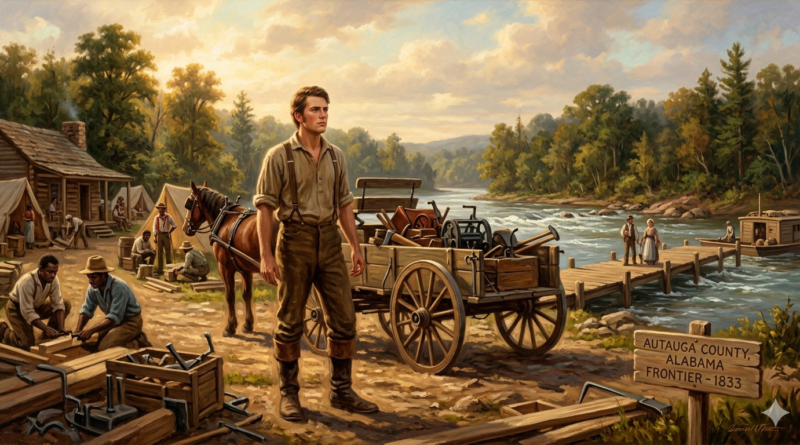
The Legacy of Daniel Clifton Pratt: The Man Who Built Prattville
The history of American industrialization is often told through the lens of Northern boomtowns, but the American South boasts its own deep-rooted stories of engineering brilliance. At the absolute center of Alabama’s industrial evolution stands one name: Daniel Clifton Pratt.
As a visionary industrialist, architect, and the legendary founder of Prattville, Alabama, Pratt transformed a primitive marshland into a thriving manufacturing powerhouse. This comprehensive guide explores the life, innovations, and deep cultural footprint of the man who single-handedly reshaped the economic landscape of the antebellum South.
Early Life and Journey to the South
Born on July 20, 1799, in Temple, New Hampshire, Daniel Pratt was raised with the classic New England work ethic. He trained early as a skilled carpenter, learning the mechanics of architecture and construction. However, the economic shifts of the early 19th century drove him to seek opportunities elsewhere.
In 1819, Pratt moved to Georgia, working as a builder before taking charge of a cotton gin factory. It was during this phase that he mastered the mechanics of Eli Whitney’s revolutionary invention. Recognizing the massive, untapped industrial potential further west, Pratt packed his designs and relocated to Autauga County, Alabama, in 1833.
Founding Prattville, Alabama: A Masterpiece of Urban Planning
When Daniel Pratt acquired land along the rushing waters of Autauga Creek, he didn’t just see a place to build a workshop—he envisioned a fully sustainable manufacturing village.
Unlike many industrialists of his era, Pratt prioritized community building alongside corporate growth. His architectural expertise directly guided the layout of the town, ensuring a clean, grid-based system that integrated industrial sites smoothly with residential life.
Key Historic Milestones of Prattville’s Growth
- 1833: Daniel Pratt purchases land and builds his first temporary blacksmith and gin shops.
- 1839: The official founding layout of Prattville is established, drawing hundreds of skilled laborers.
- 1848: Prattville is widely recognized as one of the most technologically advanced industrial towns in the deep South.
The Pratt Gin Company: Revolutionizing Global Cotton Industry
The true engine of Pratt’s empire was the Pratt Gin Company. Pratt took the basic premise of the cotton gin and re-engineered it for mass production, durability, and maximum efficiency.
| Metric / Attribute | Historic Impact & Data |
| Production Scale | Became the largest manufacturer of cotton gins in the entire world during the 19th century. |
| Global Reach | Shipped advanced cotton machinery across the American South, Europe, and into South America. |
| Technological Edge | Leveraged the natural water power of Autauga Creek to run high-output automated assembly systems. |
Because his machinery was so robust, it became the gold standard for cotton processing worldwide, securing Alabama’s spot on the international trade map well before the Civil War.
Broadening the Horizon: Industrial Diversification
Pratt understood the danger of relying on a single industry. To build a resilient economy, he systematically expanded his footprint across Autauga Creek:
- Prattville Manufacturing Co. (Textile Mill): Converted raw local cotton directly into high-grade cloth on-site.
- The Flour and Grist Mills: Provided crucial agricultural processing for local farmers, making the region entirely self-sufficient.
- Iron Foundry & Carriage Factory: Produced necessary tools, machine parts, and luxury transport vehicles for the expanding southern market.
The Civil War Era and Post-War Reconstruction
When the Civil War erupted, Pratt’s industrial complex became an irreplaceable asset for the Confederacy. The factories were partially shifted to produce uniform fabric, strategic supplies, and munitions. Pratt even helped fund a local military unit known as the Prattville Dragoons.
Despite the severe economic devastation across the South post-1865, Pratt’s diverse business strategy allowed his town to recover much faster than neighboring regions. In his later years, he invested heavily in the budding coal and iron infrastructure of Birmingham, proving his forward-thinking vision lasted until his death in 1873.
Preserving the Daniel Pratt Historic District
Today, the physical proof of Daniel Clifton Pratt’s legacy remains beautifully intact. The Prattville Historic District stands as a major point of cultural pride and tourism in Alabama.
The original brick factory buildings, the scenic dam along Autauga Creek, and the iconic historic homes showcase a preserved look into early American industrial design. For historians and tourists alike, exploring downtown Prattville is like walking directly through a living blueprint designed by Pratt himself.
Frequently Asked Questions (FAQs)
Is Daniel Clifton Pratt related to the actor Chris Pratt?
No. While Hollywood actor Chris Pratt’s late father was also named Daniel Clifton Pratt (1953–2014), the subject of this article is the historic industrialist Daniel Pratt (1799–1873), who founded Prattville, Alabama, in the 19th century. They are two completely different historical individuals.
What did Daniel Pratt do?
Daniel Pratt was a visionary American industrialist, architect, and builder. He founded the town of Prattville, Alabama, built the Pratt Gin Company—which became the largest manufacturer of cotton gins in the world—and heavily diversified early Southern manufacturing by establishing textile mills, iron foundries, and flour mills.
Where is Daniel Clifton Pratt’s grave?
The historic industrialist Daniel Pratt is buried in the Daniel Pratt Cemetery, which is a prominent historical site located within the Daniel Pratt Historic District in Prattville, Autauga County, Alabama.
What was Daniel Pratt’s age and cause of death?
The founder of Prattville, Daniel Pratt, passed away on May 13, 1873, at the age of 73. He died of natural causes after spending his final years managing his industrial empire and investing in the early coal and iron infrastructure of Birmingham, Alabama.