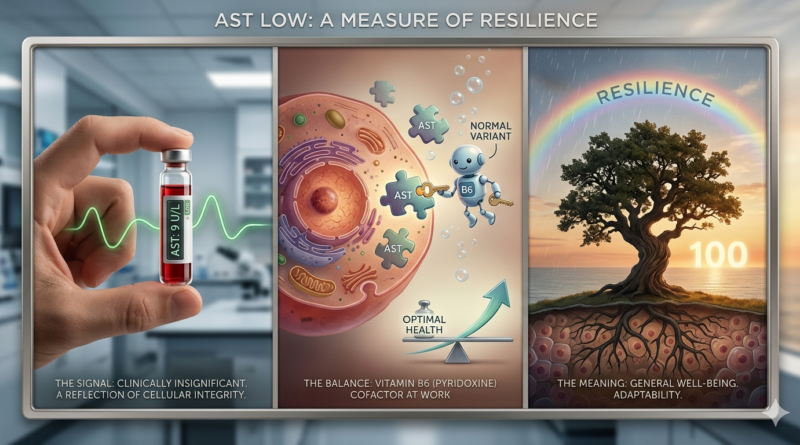
What Does It Mean If Your AST (SGOT) Blood Test Is Low?
When you receive the results of a comprehensive metabolic panel (CMP) or a liver function test, seeing numbers outside the “normal reference range” can immediately trigger anxiety. You might instantly worry about liver disease, hepatitis, or organ failure.
However, while a high AST level is a well-known indicator of liver injury, a low AST (SGOT) blood test result carries a completely different clinical meaning. In fact, in the vast majority of cases, a low AST reading is actually excellent news.
In this guide, we will break down what AST is, what constitutes a low level, the rare medical reasons behind it, and why you probably have nothing to worry about.
What is AST (SGOT)?
AST stands for Aspartate Aminotransferase (historically referred to as SGOT, or Serum Glutamic-Oxaloacetic Transaminase).
AST is an enzyme found primarily in the cells of your liver and heart, and to a lesser extent, in your kidneys, muscles, and brain. Under normal conditions, your body naturally maintains low levels of this enzyme in the bloodstream. When liver cells or muscle tissues are damaged, they rupture and leak massive amounts of AST into your blood, causing your test levels to spike.
What is Considered a “Low” AST Level?
To understand a low result, we must look at the standard laboratory reference ranges:
- Normal Range for Men: Approximately 10 to 40 units per liter (U/L)
- Normal Range for Women: Approximately 9 to 32 units per liter (U/L)
🔬 The Baseline Reality:
A “low” AST level typically means a value that falls below 9 or 10 U/L. Because the normal baseline is already very close to zero, dropping slightly below the standard range is incredibly common and usually clinically insignificant.
4 Common Reasons for a Low AST (SGOT) Blood Test
If your doctor flags your AST as lower than normal, it is rarely a sign of medical emergency. Here are the most common reasons why your numbers might be low:
1. Excellent Liver Health (The Most Common Scenario)
The simplest and most frequent explanation for a low AST level is that your liver is functioning beautifully. Because AST only leaks into the bloodstream when cells are damaged, a low amount of AST in your blood simply indicates that your liver cells are stable, healthy, and intact.
2. Vitamin B6 Deficiency (Pyridoxine)
To properly synthesize and measure AST in a laboratory setting, the enzyme requires a coenzyme called Vitamin B6 (Pyridoxine). If your diet is severely lacking in Vitamin B6, your body may produce less AST, or the lab equipment may underreport the active enzyme levels.
- How to fix it: Consuming foods rich in B6 (like bananas, chickpeas, poultry, and fish) easily corrects this variance.
3. Pregnancy
During pregnancy, a woman’s body undergoes massive physiological changes, including hemodilution (an increase in total blood volume). This extra fluid dilutes the concentration of natural chemicals and enzymes in the blood. It is entirely normal for pregnant women to exhibit slightly lowered AST and ALT levels during their second and third trimesters.
4. Advanced Chronic Kidney Disease (Rare)
In rare clinical settings, patients undergoing long-term kidney dialysis or suffering from advanced renal failure show suppressed AST levels. This is typically due to altered chemical baselines in the blood and low Vitamin B6 levels associated with uremia, rather than active liver disease.
At-A-Glance: High AST vs. Low AST
| Factor | High AST (SGOT) Levels | Low AST (SGOT) Levels |
| Typical Range | Greater than 40–50 U/L | Less than 9–10 U/L |
| Primary Meaning | Active cell damage or inflammation. | Normal cell stability or lack of enzyme leakage. |
| Common Causes | Fatty liver, alcohol usage, hepatitis, muscle injury. | Great health, pregnancy, minor B6 deficiency. |
| Clinical Concern | Requires immediate investigation. | Rarely a cause for concern. |
Do You Need to Treat Low AST?
There is no direct medical treatment to “raise” low AST levels because low levels do not cause harm to the body. However, if your doctor suspects a minor nutritional gap or lifestyle factor, they may recommend:
- Checking your Vitamin B6 levels and adjusting your diet.
- Cross-referencing your ALT (Alanine Aminotransferase) levels. If both ALT and AST are low, it further confirms a completely healthy, unstressed liver.
Conclusion
If your latest blood work shows a low AST (SGOT) level, you can take a deep breath. Unlike a high result, which warns of inflammation, a low result is usually the body’s way of showing that your liver is resting in a healthy, undamaged state. Unless your physician points out specific underlying symptoms or nutritional deficiencies, a low AST score is a green light for your health.