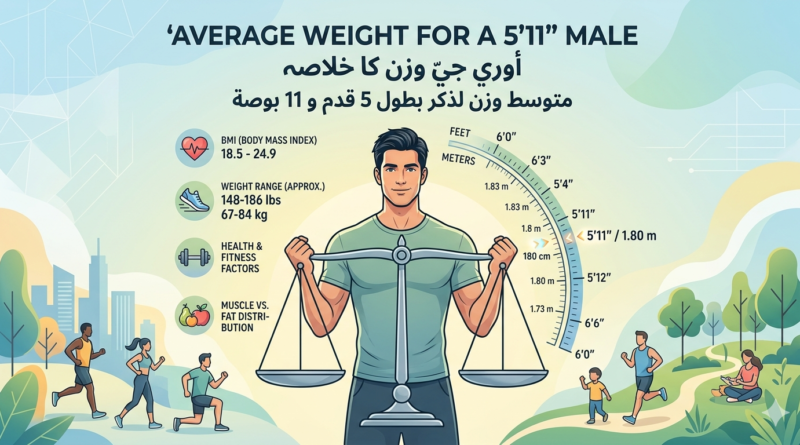
What Is the Average Weight for a 5’11” Male? Healthy Ranges & Ideal Weight Charts
When evaluating your health and fitness goals, height and weight proportions are the most common baselines to consider. If you are a 5’11” (180 cm) male, you might be wondering where your current weight stands compared to national averages and clinical medical standards.
Is the average weight necessarily the healthiest weight? Not always.
In this comprehensive guide, we will break down the statistical average weight for a 5’11” man, explore the official BMI (Body Mass Index) healthy weight categories, and look at how body frame sizes alter these numbers.
1. The Statistical Average vs. The Healthy Ideal
There is a major difference between the “statistical average” (what an average man actually weighs) and the “ideal medical weight” (what a man should weigh for optimal longevity).
- The Statistical Average: According to recent data from the Centers for Disease Control and Prevention (CDC), the statistical average weight for an adult American male over the age of 20 is approximately 199.8 pounds (90.6 kg). Since the average male height is about 5’9″, a 5’11” man in the general population often weighs anywhere between 200 to 210 pounds.
- The Clinical Ideal: According to insurance charts and medical guidelines, the ideal healthy weight range for a 5’11” male is significantly lower, sitting between 136 and 178 pounds.
2. Healthy Weight Ranges Based on BMI Categories
Doctors and nutritionists globally use the Body Mass Index (BMI) to categorize weight health. For a man standing at 5 feet 11 inches, here is how the weight brackets break down across the BMI spectrum:
| Weight Range (Pounds) | Weight Range (Kilograms) | BMI Classification | Health Implications |
| Below 132 lbs | Below 60 kg | Underweight | Risk of nutritional deficiencies / low immunity. |
| 136 to 178 lbs | 61.7 to 80.7 kg | Normal / Healthy Weight | Lowest risk for chronic metabolic cardiovascular diseases. |
| 179 to 214 lbs | 81.2 to 97.1 kg | Overweight | Increased strain on joints and heart. |
| 215 lbs and above | 97.5 kg and above | Obese | High clinical risk for Type 2 Diabetes and Hypertension. |
3. Adjusting Weight According to Body Frame Size
A common flaw of the standard BMI chart is that it ignores bone structure and muscle mass. A 5’11” man with a large bone structure or significant muscle mass will naturally weigh more without being unhealthy.
The Metropolitan Life Insurance Company established ideal weight ranges based on three distinct Body Frame Sizes:
- Small Frame: 140 to 148 lbs (63.5 – 67.1 kg)
- Medium Frame: 145 to 157 lbs (65.8 – 71.2 kg)
- Large Frame: 152 to 172 lbs (68.9 – 78.0 kg)
If you lift weights regularly or are an athlete, your lean muscle tissue weighs more than fat. Therefore, a muscular 5’11” man might weigh 190 to 195 pounds with a low body fat percentage, making him incredibly healthy despite what standard charts say.
Frequently Asked Questions (FAQs)
Q1: Is 200 lbs overweight for a 5’11” male?
Technically, yes. According to the standard BMI scale, a weight of 200 lbs puts a 5’11” male at a BMI of 27.9, which falls into the Overweight category. However, if you are a bodybuilder or have high muscle mass, this weight could still be healthy. If it is primarily body fat, it is recommended to bring it down closer to 180 lbs.
Q2: What is the ideal waist size for a 5’11” man?
For a 5’11” male, a healthy waist circumference is under 40 inches (101.6 cm). Ideally, to minimize visceral fat risks (fat around internal organs), your waist size should be less than half of your height, which equals 35.5 inches or lower.
Q3: How many calories should a 5’11” male eat to maintain weight?
An average sedentary 5’11” man requires approximately 2,200 to 2,400 calories per day to maintain his weight. If you are moderately active or exercise 3-5 times a week, that number increases to 2,600 – 2,800 calories.
Q4: Why does the ideal weight range have such a wide gap (136 to 178 lbs)?
The 42-pound gap exists to accommodate natural human diversity. It accounts for differences in age, genetic bone density, muscle distribution, and metabolic baselines among individual men.
Conclusion
Determining your ideal weight as a 5’11” male shouldn’t rely on a single number. While medical charts suggest staying between 136 and 178 pounds, your personal composition—muscle mass, bone structure, and overall body fat percentage—plays a vital role. Focus on healthy nutrition, strength training, and waist measurements rather than just chasing a number on the weighing scale.